Munmudo Academy
The school and public institution being developed for South Denver—the place where standards, relationships, training, and service become lived culture.
Explore the academy → Munmudo AcademyScholar. Warrior. Leader.
Mun Ji Kwan Taekwondo · 문지관 태권도
Munmudo Academy is the institutional home of Mun Ji Kwan Taekwondo—a disciplined approach to scholarship, martial skill, and service-minded leadership. The academy brings technical practice, practical readiness, historical study, character, and responsibility into one coherent educational path.
One Project · Three Expressions
Munmudo Academy, Mun Ji Kwan Taekwondo, and The Mun Ji Kwan Canon are distinct parts of one undertaking. Each has its own role; together they align institution, practice, and doctrine.
The school and public institution being developed for South Denver—the place where standards, relationships, training, and service become lived culture.
Explore the academy →The integrated curriculum doctrine and teaching method through which scholarship, martial skill, practical readiness, and leadership develop together.
Explore the system →The developing body of work that articulates the project’s philosophy, institutional purpose, standards, responsibilities, and method of transmission.
Explore the Canon →01 · The Standard
“What kind of person should be entrusted with strength?”
Every class, rank, and responsibility returns to this question. Technical ability matters. So do judgment, restraint, understanding, and service.
Munmudo Academy treats character as part of martial competence rather than as decoration around it. Confidence must be joined to self-control; authority must be earned through conduct; and progress must be measured not only by what a student can perform, but by how that student responds to difficulty, responsibility, and other people.
Founder & Author
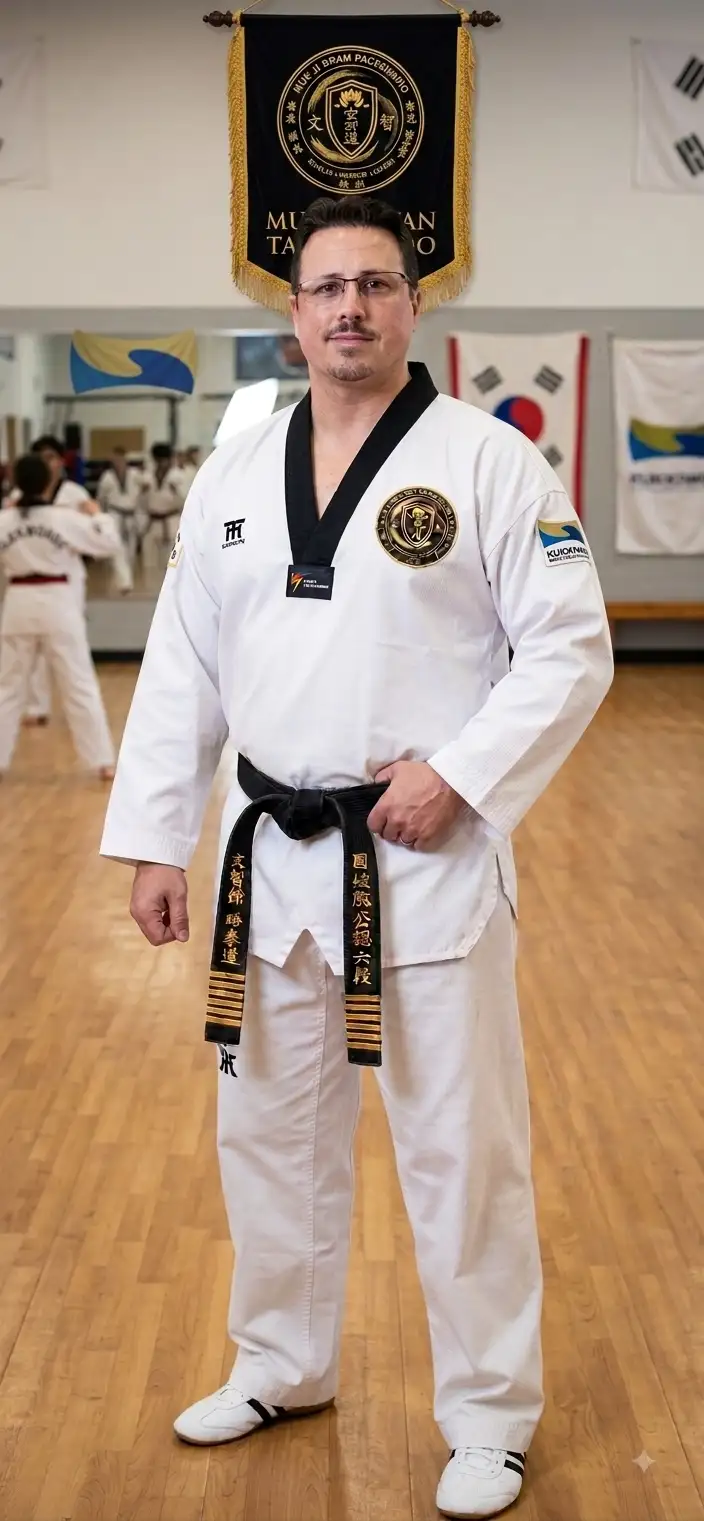
Miguel Thomas Gonzalez is the founder of Munmudo Academy and the author of The Mun Ji Kwan Canon.
His work develops Mun Ji Kwan as a coherent school doctrine and curriculum architecture: a way to reunite technical discipline, historical literacy, practical readiness, philosophical study, and leadership formation.
The academy grows from a conviction that martial education should develop the whole person. Physical training is therefore placed alongside emotional control, reflective study, practical responsibility, and the gradual preparation to guide others.
The project is offered with respect for established Taekwondo authorities and lineages. It does not claim to replace Kukkiwon, World Taekwondo, the ITF tradition, or the historic kwans. Its purpose is to give inherited elements a clear educational relationship within one disciplined school method.
Full founder profile →The Martial System
문지관 · 文智館
Mun points toward study, culture, and written tradition. Ji points toward wisdom, discernment, and judgment. Kwan is the hall or school in which those qualities are cultivated through martial practice.
Study, historical awareness, reflection, and disciplined understanding give power direction. Students are taught to ask why a method exists, what it preserves, and how its principles should shape conduct.
Strong fundamentals, practical application, poomsae, sparring, and self-defense make training real. Technique is expected to remain controlled, structurally sound, adaptable, and understandable beyond surface performance.
Restraint, responsibility, service, and transmission make rank meaningful. Seniority brings an increasing duty to protect standards, support junior students, communicate clearly, and represent the academy well.
Mun Ji Kwan is best understood as an integrated curriculum doctrine and pedagogical method—not a claim to supersede recognized Taekwondo institutions. The system seeks wholeness: tradition without stagnation, modern relevance without historical amnesia, and power governed by wisdom.
The Written Foundation
Book I
A Constitutional Philosophy of Martial Education
The opening volume establishes the philosophical and institutional foundation of the Mun Ji Kwan project: strength governed by wisdom, rank understood as responsibility, and martial education directed toward the formation of capable, thoughtful, and honorable people.
It asks what a martial school is for, what obligations accompany authority, and how philosophy can become visible in training rather than remain ceremonial language. The work provides the governing ideas from which curriculum, testing, instruction, leadership, and school culture can proceed coherently.
The broader Canon serves as the written counterpart to the academy’s embodied practice. It brings purpose, standards, authority, tradition, and transmission into one continuing argument.
The website presents the project’s public argument and scope. The full Canon, detailed curriculum, and internal teaching materials remain private.
Explore the Canon overview →Explore Book I →Publication information forthcoming.
A Living Philosophy
A complete martial education must hold several truths together. Skill without reflection can become reckless. Reflection without embodied discipline can become abstract. Tradition without examination can become rigid, while constant novelty can leave a student without roots.
Mun Ji Kwan asks more of the black belt than performance. Can the practitioner understand, protect, teach, and transmit? Black belt is treated as the beginning of responsibility rather than the end of achievement.
Character is not decorative language. It is tested through conduct, emotional control, responsibility, service, and judgment under pressure. Sparring becomes a lesson in composure; self-defense becomes a study of restraint; rank becomes accountable service.
Mastery is not domination. It is the disciplined unity of mind, body, technique, culture, and ethical purpose. The mature practitioner seeks effectiveness without cruelty, confidence without vanity, and authority without self-importance.
Lineage & Synthesis
Synthesis is useful only when its sources remain recognizable and its choices are governed by a coherent purpose. Mun Ji Kwan brings complementary strengths into relationship without pretending that their histories, organizations, or technical emphases are identical.
Read the complete lineage position →Strong fundamentals, direct mechanics, technical discipline, and practical orientation form the structural spine of the method. Advanced training returns repeatedly to posture, balance, chamber, alignment, decisive movement, and the practical meaning of technique.
The civil-martial ideal gives the system its educational soul: scholarship, character formation, meaningful tradition, self-defense, and ethical responsibility. The practitioner is expected to become both capable and thoughtful.
Standardized poomsae, modern biomechanics, recognizable structure, and contemporary athletic development provide a shared modern Taekwondo framework. This stream supports disciplined progression and technical legibility.
Historical consciousness, moral narrative, Korean cultural memory, and traditional application preserve a literary and heritage dimension. Forms are approached as subjects for study as well as sequences for performance.
These traditions are presented as respected pillars of an integrated educational doctrine. Mun Ji Kwan does not erase their distinctions or claim institutional authority over them. Any future public expansion of lineage statements will remain historically careful and subject to senior review.
Munmudo Academy is being developed as a disciplined training environment for students and families seeking more than sport participation.
The intended program treats Taekwondo as a structured developmental path. Students build physical skill and practical readiness while learning etiquette, emotional regulation, historical awareness, reflective habits, and responsibility to the training community.
Progress is meant to be earned by standard rather than automatic attendance. Forms, fundamentals, sparring, self-defense, philosophy, conduct, and leadership each contribute to a student’s development; no single area is treated as the whole art.
The intended culture pairs challenge with dignity, correction with clarity, and advancement with meaningful standards. Students should understand what they are developing and why it matters.
Program schedule, location, tuition, age groups, enrollment process, and opening date will be announced when confirmed.
Explore the Project
The deeper pages below present the project’s public-facing identity and arguments. They do not disclose the full Canon, detailed curriculum, internal testing standards, or instructor materials.
The founder, author, and relationship among the academy, system, and written work.
Read profile →02 · SystemName, identity, training method, Scholar–Warrior–Leader doctrine, and public scope.
Explore system →03 · CanonPurpose, governing questions, institutional relationships, and the opening volume.
Explore Canon →04 · PhilosophyPower, restraint, rank, responsibility, and the habits through which ideas become conduct.
Read philosophy →05 · LineageFour streams of influence, rules of integration, and explicit institutional boundaries.
Read position →06 · AcademyThe developing South Denver model, teaching pillars, class experience, and promotion philosophy.
Explore academy →07 · Book IThe constitutional philosophy that opens The Mun Ji Kwan Canon.
Explore Book I →How to Read This Site
The website is designed to explain the academy’s purpose with enough substance for families, practitioners, senior masters, and publishers to understand the project while keeping detailed curriculum and unpublished work in their proper educational and editorial context.
The institutional identity, central philosophy, relationship among academy, system, and Canon, public biography, and verified contact information are presented directly.
Facility, schedule, age groups, tuition, enrollment, opening date, and publication details remain forthcoming and will be added only when confirmed.
The full Canon, detailed rank curriculum, testing standards, lesson architecture, instructor materials, and internal development resources are not published here.
Contact
Munmudo Academy welcomes serious conversation about the school, its educational philosophy, the Mun Ji Kwan system, and the written Canon.
Publisher, senior-master, community, and prospective-family inquiries are welcome. A dedicated contact page explains the appropriate paths and current operational boundaries in greater detail.
contact@munmudoacademy.comSouth Denver, Colorado